Grace Counselling Centre
Psychospirituality: Christian Counselling and Mental Health
Kirby Chua
Nov 24, 2026

In my work as a Christian counsellor, I have been given a unique perspective on the problem of human pain and suffering.
Let us look at the behavioural and psychological problems around the world today. As counsellors and therapists, we encounter a wide range of issues. We deal with anger and violence, with people hurting one another, even members of their very own families. We encounter problems stemming from anxiety and fear, manifesting as phobias, trauma and avoidant behaviours. We see insatiable needs and desires that may contribute to addictions, compulsions and obsessive behaviours.
How about you? What unhealthy patterns are you struggling with today?
There is certainly no shortage of problems to address in the field of mental health. Yet, when confronted with all these difficulties, we must eventually ask one fundamental question: "Why?"
Is it a problem of our actions? Our reactions? Is it a problem with the way we think? What about the way we feel? Or could the problem be spiritual?
Understanding Human Suffering: Different Perspectives
I have always aspired to make the world a better place, one person at a time. As a psychotherapist, I recognise that an effective treatment plan begins with an accurate understanding of the problem.
When it comes to the difficulties mentioned above, what exactly is the underlying problem? Interestingly, the answer often depends on whom we ask.
Friends and family members may perceive the problem at the behavioural level, focusing on what a person does or fails to do.
Medical doctors and psychiatrists may examine the problem from a physiological or medical perspective, considering biological and biochemical factors.
Counsellors and psychologists may conceptualise the problem through psychological frameworks, examining thoughts, emotions, beliefs and behavioural patterns.
Pastors and religious leaders may approach the problem from a spiritual perspective, considering the person's faith, spiritual life and relationship with God.
Sociologists and social workers may examine the influence of the social environment, family systems and societal pressures.
Each perspective offers a potentially valuable explanation of human suffering. Naturally, the way we conceptualise a problem influences how we attempt to resolve it.
This brings me to a conceptual chart that I presented in 2016 in my book, The Bible's Secrets to Counselling.
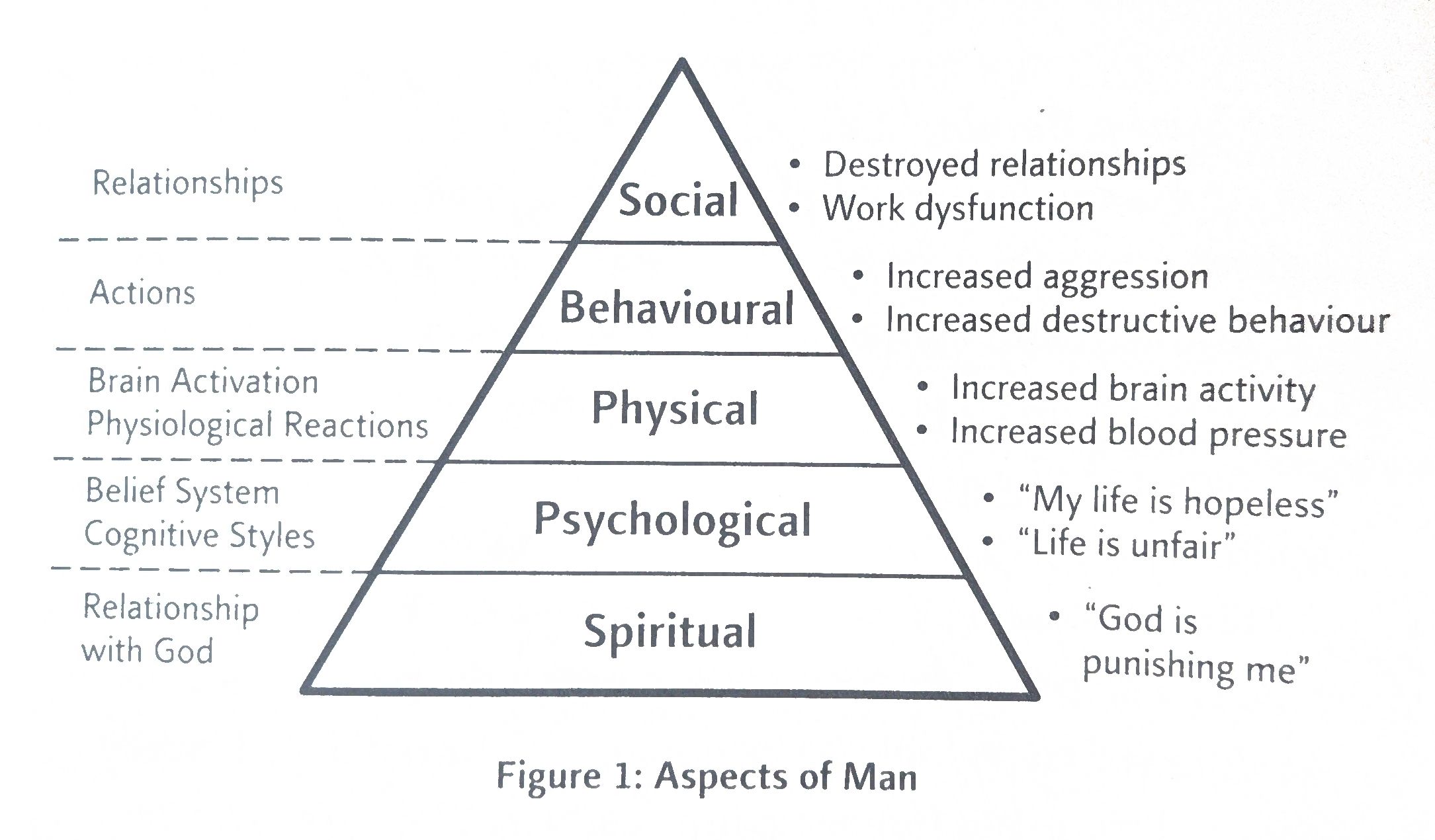
The chart illustrates how human problems can be conceptualised at different levels, corresponding to different aspects of human existence. But what if we are overlooking an important area between these dimensions?
Psychospirituality
Through my experience in psychotherapy and Christian counselling, I have come to believe that many of the problems we experience, both individually and collectively, are influenced by our understanding of spiritual realities and how we apply them to our earthly lives.
This brings me to what I refer to as the psychospiritual region or aspect.
I define psychospirituality as the interface between the psychological and spiritual dimensions of human existence; through which spiritual beliefs and truths are translated into psychological experiences and everyday living.
It is not merely concerned with the psychological aspect of man, nor is it concerned exclusively with the spiritual.
Rather, it is the bridge between the two.
The psychospiritual region concerns our psychological understanding of spiritual realities, particularly our relationship with God. It also concerns how our spiritual beliefs influence our thoughts, emotions, decisions and behaviours.
A person may possess a spiritual truth without having fully internalised its psychological implications.
For instance, a Christian may know that God loves him and yet continue to perceive himself as worthless. He may believe in God's forgiveness and yet remain imprisoned by guilt. He may believe that God is sovereign and yet be overwhelmed by anxiety about the future.
There is a difference between knowing a spiritual truth and experiencing the psychological implications of that truth.
It is within this gap that I believe much of the work of Christian counselling takes place.
Understanding Depression Through the Psychospiritual Framework
Let us take sadness and depression as an example. Depending on the theoretical framework employed, we may arrive at different explanations and approaches to treatment.
Social Workers who believe that depression was brought about by environmental stress and social demands would address the elimination of the stressors and strengthening social support.
Behaviourists (I earlier used friends and family) who see the problem as composed of a series of one's actions would focus on changing your behaviour. Like tell you to smile when you're frowning, or eat more when you don't have the appetite. To go out more when they see you rotting in your bedroom.
Medical practitioners who believe in the biochemical causes of depression will most probably hand you medications that will alter your chemical levels. Like sleeping pills if you cannot sleep or stimulants if you are too inhibited.
Psychologists and Counsellors will deal with the psychological realities of the depressed. Mainly with their belief system and their recurring thoughts. This is why we use counselling and other psychotherapeutic methods.
At the bottom of the chart is the most fundamental aspect that defines us as human beings, the spiritual aspect. Pastors, church ministers, spiritual leaders will address the spirit when dealing with depression, believing that the problem lies therein. What method would they employ? Seek help with your church and they will pray for you, teach you to pray, worship with you, read the word with you, and all those spiritual stuff.
Here, I would like to point out the aspect which we deal with in Christian Counselling: The Psychospiritual Aspect. We conceptualise depression from the failure to internalise spiritual truths and applying them to our daily life. Though the spirit is thriving, saved in Christ, the mind's faulty beliefs discard God's grace and disqualified the earthly flesh from His blessings.
Notice how each proposed intervention corresponds to the way the problem is conceptualised.
However, the chart itself cannot tell us which explanation is correct for a particular individual. Nor does it suggest that these explanations are mutually exclusive. Human suffering is often complex, involving several dimensions simultaneously.
What I would like to highlight is that addressing the spiritual dimension alone, through prayer and worship for example, may not necessarily resolve a person's depression if spiritual truths have not been integrated into his psychological and everyday life.
There are countless believers who are loved by the Lord Jesus Christ and yet experience profound psychological suffering. Even some of the most faithful figures in Scripture experienced despair, anguish and emotional exhaustion.
Consider Elijah in 1 Kings 19, David's expressions of anguish throughout the Psalms, and Job in the midst of his suffering.
Their suffering was not necessarily an indication of their spiritual standing before God.
A person can be spiritually secure in Christ and yet remain psychologically troubled.
On the other side of the coin, psychotherapy that addresses only the psychological dimension may leave important spiritual concerns unexplored.
Having worked within psychological frameworks, I have found that purely psychological approaches can be insufficient when dealing with deeply spiritual themes and questions of existence.
As a Christian psychotherapist, how can I speak comprehensively about forgiveness, love, righteousness, goodness and wisdom without ultimately orienting these concepts towards the Lord Jesus Christ?
For the Christian, these are not merely psychological or philosophical concepts. They are spiritual realities grounded in the very character of God.
The Lord Jesus Christ and Psychospiritual Transformation
I believe that an important aspect of the earthly ministry of the Lord Jesus Christ was His engagement with the psychospiritual dimension of man.
He revealed spiritual truths that challenged people's beliefs, called them to repentance and transformed their understanding of life.
In John 9, the healing of the man born blind was accompanied by Christ's revelation that He is the Light of the World.
In John 11:25, before raising Lazarus from the dead, the Lord Jesus declared:
I am the resurrection, and the life.
These miracles were not merely demonstrations of supernatural power. They also revealed spiritual truths that challenged and transformed people's understanding of reality.
Christ did not simply address the physical condition of man. He also addressed the beliefs through which man understood God, himself and the world around him.
The Apostle Paul similarly writes in Romans 12:2:
"And be not conformed to this world: but be ye transformed by the renewing of your mind."
Notice that Paul was addressing believers. These were people who already belonged to Christ, yet the renewal of their minds remained an essential part of their transformation.
Here we see a distinction between our spiritual position in Christ and the ongoing transformation of our earthly lives.
Salvation establishes our spiritual position in Christ. However, there remains a process through which spiritual truths are internalised, understood and manifested in the way we live.
I conceptualise an important part of this process as psychospiritual transformation.
The Role of Christian Counselling in Psychospiritual Transformation
I wish that prayer alone would immediately change every difficult circumstance we face. However, our experiences tell us that this is not always the case. This does not diminish the power of prayer, nor does it suggest that God is unable to intervene. Rather, it reminds us that spiritual growth, psychological transformation and changes in our earthly circumstances do not necessarily occur at the same time. This is where I believe Christian counselling has an important role to play.
Christian counselling, as I conceptualise and practise it, deals substantially with the psychospiritual dimension of man. It seeks to help individuals understand spiritual truths and integrate them into their psychological functioning and everyday lives. If you believe that you need prayer, spiritual guidance or more time spent in the Word of God, by all means, pursue these spiritual practices. But do not lose hope if your psychological struggles persist.
Your anxiety does not necessarily mean that you lack faith. Your sadness does not necessarily mean that God has abandoned you. Your psychological suffering does not diminish God's love for you.
Let's be open, perhaps there are areas of your psychospiritual life that require attention; where what you know spiritually has yet to become fully integrated into how you think, feel and live. This is the bridge between psychology and spirituality that I seek to address through Christian counselling.
Christian Counselling and Psychospiritual Well-Being in Singapore
Are you struggling with anxiety, depression, anger, guilt, relationship difficulties or other emotional challenges despite your faith in God?
Do you find yourself knowing the promises of God but struggling to experience their implications in your everyday life?
At Grace Counselling Centre, our approach to Christian counselling recognises the importance of both psychological well-being and spiritual life. Through Christian counselling and psychotherapy, we seek to help individuals explore the relationship between their faith, beliefs, emotions and behaviours.
You do not have to choose between caring for your mental health and nurturing your relationship with God.
There is a bridge between the two.
This is what I call psychospirituality.
If you would like to explore how Christian counselling can help you with your psychological and spiritual struggles, contact Grace Counselling Centre in Singapore to arrange a counselling session.
Christian counselling can complement appropriate medical and psychiatric care when necessary.